
LCC
The release of NO from [Ru-NO] is regarded as a property of the excited state, following absorption that can be achieved with 1 photon (OPA) or 2 photons (TPA) according to the diagram below:
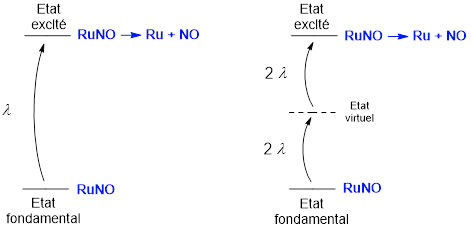
NO photo-release at 1 photon (OPA, left) or at 2 photons (TPA, right)
While the study of NO release can be characterized very well by OPA in the laboratory, the compounds will need to be irradiated with two photons (TPA) during actual medical applications in biological environments, which involves determining the TPA properties quantified by the molecular cross section (σTPA) expressed in Goeppert-Mayer (GM).
1. Monometallic complexes
In these dipolar complexes, optimization of TPA properties aims to increase charge transfer between the electron donor (D) and the nitrosyl acceptor by introducing a conjugated bond on the ligand.
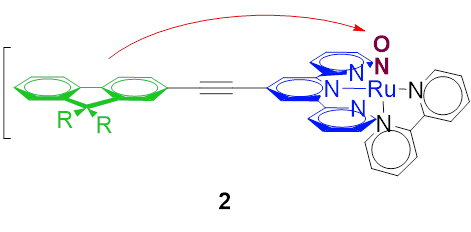
Thus, complex 2, shown below, contains a -C≡C- fragment that increases the D – NO distance. This results in an increase from σTPA = 108 GM in reference complex 1 to σTPA = 150 GM under 800 nm irradiation. (Eur. J. Inorg. Chem. 2021, 1670-1684).
2. Polymetallic complexes
The dipolar approach leads to chromophores with limited σTPA. Therefore, other systems with more sophisticated electronic properties have been studied. In particular, bimetallic species consisting of two conjugated monometallic subunits, such as complex 3 below:

Bimetallic compounds of this type can all be considered electronically pseudo-centrosymmetric. A remarkable point is that their associated σTPA greatly exceeds twice that of basic monometallic complexes. Thus, σTPA = 1523 GM for 3, under irradiation at 700 nm, which is a record for our bimetallic [Ru-NO] complexes. (Chem. Eur. J. 2022, 28, e202201692, 1-14).
A complete kinetic study was conducted by OPA in acetonitrile, based on the following model:

The model, developed specifically for this study, allows the precise determination of photo-release quantum yields (ΦNO = moles of NO released / moles of photons absorbed).
The values of ΦNO are in the range of 0.1%–3% for all irradiation wavelengths (365, 400, 455, 490 nm), with a marked tendency for higher values of ΦNO in step 1.
(Inorg. Chem. 2024, 63, 7665-7677, Ph.-D. Yael Juarez Martinez).
LCC CNRS
Laboratoire de chimie de coordination du CNRS
205 route de Narbonne, BP 44099
31077 Toulouse cedex 4
France
+ 33 5 61 33 31 00