

ANR MNP@CCM
Aqueous biphasic catalysis with Metal NanoParticles
at Core-Crosslinked Micelle nanoreactors (MNP at CCM)
Funding Reference
ANR MNP@CCM (ANR-24-CE07-6647-01 ; 2024-2028, coordinator K. Philippot) : collaboration LCC-LCAC (R. Poli et E. Manoury) and IFPEN-Lyon (L. Magna et J. M. Asensio Revert) ; Global budget = 604 729,14 €

Abstract
The incorporation of metal nanoparticles (MNPs) into the hydrophobic cores of cross-linked amphiphilic polymer micelles (CCMs) represents an innovative concept for aqueous biphasic nanocatalysis as it combines “homogeneous” reaction conditions with “heterogeneous” catalyst recovery (see references below). Indeed, CCMs form stable aqueous dispersions while catalytic transformation occurs within the “homogeneous” core-cross linked polymer micelle core and the product/catalyst separation is accomplished by simple phase decantation. Activities and selectivities obtained with MNPs dispersed in an organic medium can enable the design of novel CCMs based on core engineering for aqueous biphasic hydrogenations and hydrogenolysis/hydrodeoxygenations, with particular attention to recycling and sustainability concerns (increasing the efficiency of the use of metals, of particular for noble metal Rh).
The MNPatCCM ANR project aims at optimising the performance of such catalytic nanoreactors based on Rh and Ni NPs anchored in ligand-functionalized cores of CCMs for hydrogenation and hydrogenolysis/hydrodeoxygenation reactions. The anchoring ligands in CCMs can be introduced using polymerizable versions of the molecular stabilizers previously investigated in organic colloidal dispersions. The effect of added bases will be investigated in order to determine the relevance of integrating such a promoter in the CCM structure for guiding the hydrogenation activation and improvement of catalytic performance. After improving the catalytic performance of Rh-loaded catalytic nanoreactors, the synthesis strategy will be extended to Ni systems, a first-row abundant metal. This will allow addressing a key concern in catalysis, namely to replace noble metals by less critical ones, in terms of abundance and cost. The substrate screening and condition optimisation will take advantage of methods adapted to determine the relevance of the best catalysts at the industrial scale. The ultimate goal will be to perform economic analysis and life cycle assessment for the most promising catalytic reactions with substrates of industrial interest.
Previous References:
- Rhodium nanoparticles inside well-defined unimolecular amphiphilic polymeric nanoreactors: synthesis and biphasic hydrogenation catalysis, H. Wang, A. M. Fiore, C. Fliedel, E. Manoury, K. Philippot, M. M. Dell’Anna, P. Mastrorilli, R. Poli, Nanoscale Advances, 2021, 3, 2554-2566 (https://doi.org/10.1039/D1NA00028D).
- Confinement of Rh nanoparticles in triphenylphosphine oxide-functionalized core-crosslinked micelles for aqueous biphasic hydrogenation catalysis, C. J Abou-Fayssal, C. Fliedel, R. Poli , A. Riisager, K. Philippot, E. Manoury, Materials Today Chemistry, 2023, 34, 101752 (https://doi.org/10.1016/j.mtchem.2023.101752).
- Polymeric nanoreactors for catalytic applications, C. J. Abou-Fayssal, R. Poli, K. Philippot, A. Riisager, E. Manoury, CR Chimie, 2024, 27, 1-23 (https://doi.org/10.5802/crchim.301).
- One-pot synthesis of Rh nanoparticles in polycationic-shell, triphenylphosphine oxide-functionalized core-crosslinked micelles for aqueous biphasic hydrogenation, C. J. Abou-Fayssal, L. Schill, R. Poli*, E. Manoury, K. Philippot, A. Riisager, ChemCatChem, 2024, e202400189 (7 of 10) (https://doi.org./10.1002/cctc.202400189).
- Rh nanoparticles confined in triphenylphosphine oxide-functionalized core-crosslinked micelles with a polyanionic shell: synthesis, characterization, and application in aqueous biphasic hydrogenation, C. J. Abou-Fayssal, L. Schill, R. Poli, A. Riisager, E. Manoury, K. Philippot, Reactive and Functional Polymers 2024, 205, 106061 (https://doi.org/10.1016/j.reactfunctpolym.2024.106061).
General Scheme of Aqueous biphasic catalysis with CCM nanoreactors and Working Hypothesis
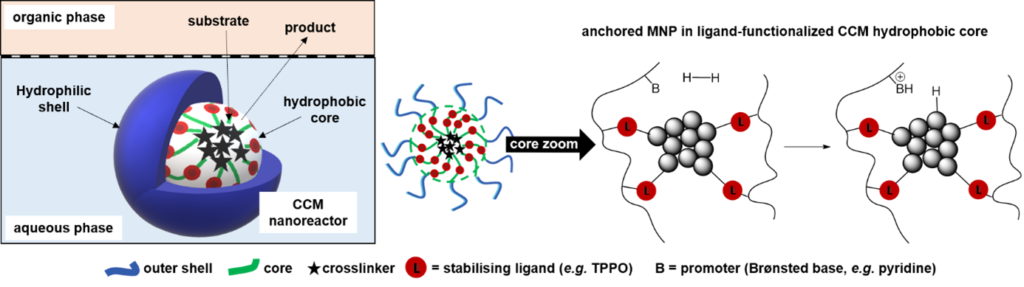
Fig. 1. Aqueous biphasic catalysis with CCM nanoreactors (left). Possible action of a base promoter for H2 activation by a MNP (right).
Project Consortium and Workpackages
The consortium of the MNPatCCM project comprises three partners, including two different groups of the Laboratoire de Chimie de Coordination in Toulouse (LCC-CNRS, UPR 8241, Toulouse) :
– the “Engineering of Metal Nanoparticles” (LCC-EMN; Partner 1) team, with Nuria Romero et Karine Philippot,
– the “Ligands, Complex Architectures and Catalysis” (LCC-LCAC; Partner 2) team, with Eric Manoury and Rinaldo Poli
and as third partner, Lionel Magna and Juan Manual Asensio Revert, from catalysis department at IFP Energies Nouvelles (IFPEN) in Lyon.
Planned for 42 months (1/10/2024-31/03/2028), the project is structured into 3 interconnected scientific work packages (WP2-4) distributed between the partners according to their expertise. It is coordinated by Karine Philippot (LCC-EMN; Partner 1).
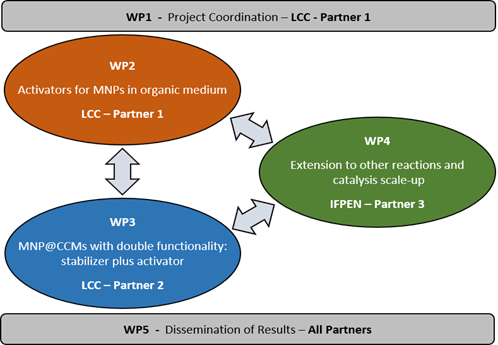
Figure 2 : Structure du projet
Participation of Young Researchers
LCC-P1: Chantal Abou Fayssal (postdoc; March 2025; 30 months); supervision by K. Philippot and N. Romero and Zeineb Jeridi (internship; Engineer INSAT Tunis; February 2026; 6 months)
LCC-P2: Mohammad Zaitoun (PhD student; October 1st, 2025; 36 months), supervision by Eric Manoury (PhD director), Rinaldo Poli.
IFPEN-P3: Zachary Sachiel Dubrawski (postdoc; December 1st, 2025; 18 months), Lionel Magna (LM), Juan-Manuel Asensio Revert (JMAR)
One Master student from INSAT in Tunisia joined the LCC-P1 in 2026, and two other Master students will join the LCC-P2 and IFPEN-P3 partners in 2027.
LCC CNRS
Laboratoire de chimie de coordination du CNRS
205 route de Narbonne, BP 44099
31077 Toulouse cedex 4
France
+ 33 5 61 33 31 00