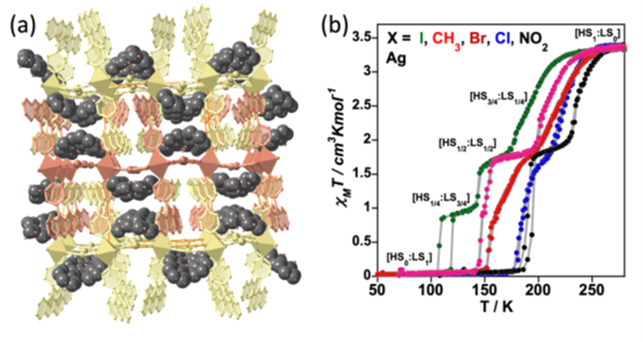
Hofmann-type clathrates constitute one of the most versatile families of coordination frameworks displaying spin-crossover (SCO) behaviour, offering unparalleled opportunities for tuning bistability from bulk materials to nanoparticles and thin films. Over the past two decades, significant advances in synthetic methodologies have been achieved, particularly through the use of tetra- and di-cyanometallate building blocks ([M
II(CN)4]
2 –, [MI(CN)2]
–) combined with mono- or bidentate bridging organic ligands. These strategies have enabled the construction of structurally diverse FeII-based frameworks exhibiting cooperative and often abrupt spin transitions. This review highlights recent progress in bulk synthesis, structural engineering, and property modulation in Hofmann-type SCO complexes. It emphasizes how dimensionality, ligand design, and metal-metal connectivity govern transition temperatures, hysteresis, and multistep behavior. In this bulk regime, particular attention is devoted to the interplay between spin transition and electron transfer in mixed-valence or redox-active clathrates, which emerges as a powerful handle to encode and expand multifunctional responses. A considerable research effort has also focused on downsizing these materials into nanoparticles while maintaining, or even enhancing, cooperativity. This approach unlocks new prospects for solution processability, surface functionalization, and device integration.Parallel advances in host-guest chemistry demonstrate that these flexible frameworks can encapsulate neutral or charged species, leading to pronounced modulation of SCO behavior, guest-triggered phase transitions, and stimuli-responsive properties. Particular attention is devoted to 2D and 3D host-guest systems and to the emergence of “active” guest molecules capable of mechanical, electronic, or photonic coupling with the SCO matrix. Moreover, advances in the fabrication of thin films, micro-structured architectures, and nanostructured surfaces are increasingly positioning Hofmann-type clathrates at the forefront of applications in molecular electronics, memory devices, spintronics, sensing, and photo-switching. Yet, despite their remarkable functional potential, their practical implementation in devices remains limited. This is likely owing to their intrinsic fragility and the challenges associated with their manipulation, processing, and integration into innovative device architectures. Additional efforts are therefore required, particularly in the development of advanced nanotechnologies, to ultimately translate these materials into genuine societal applications. This review provides a comprehensive account of the field, underscoring key structure-property relationships across multiple length scales. It also outlines current challenges and opportunities for developing high-performance, multifunctional SCO Hofmann frameworks for emerging technologies.