LCC
Chemical recycling of post-consumer plastics: phosphine-free manganese-catalysed hydrogenative depolymerisation of polyesters, polycarbonates, and polyurethanes
Published in Journal of Catalysis
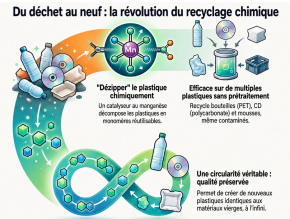
Teams from the Laboratory of Coordination Chemistry (CNRS) and the European School of Chemistry, Polymers and Materials (CNRS/University of Strasbourg) have recently developed a catalyst capable of breaking down plastic waste, such as PET (polyethylene terephthalate) bottles, into reusable monomers, under mild conditions and without the need for pre-treatment.
Hydrogenative depolymerisation of polyesters, polycarbonates, and polyurethanes was achieved on untreated post-consumer goods (bottles, packaging, textiles) using a phosphine-free manganese catalyst. Complete conversion to monomeric diols occurs under mild conditions (0.5 mol% catalyst, 60 bar H2, 150 °C), enabling sustainable chemical recycling with an earth-abundant metal.
Reference
Chemical recycling of post-consumer plastics: phosphine-free manganese-catalysed hydrogenative depolymerisation of polyesters, polycarbonates, and polyurethanes
Mariia Hruzd, Moifica Check Moïdine, Carine Duhayon, Stéphanie Bastin, Vincent Ritleng, Eric Pollet, Jean-Baptiste Sortais,
Journal of Catalysis, Volume 461, 2026, 116990, ISSN 0021-9517,
https://doi.org/10.1016/j.jcat.2026.116990
Funding:
This research was supported by the CNRS and the Institute for Advanced Studies at the University of Strasbourg (USIAS), as part of the French national programme ‘Investment for the Future’ (IdEx-Unistra)
@Stéphanie Bastin
LCC CNRS
Laboratoire de chimie de coordination du CNRS
205 route de Narbonne, BP 44099
31077 Toulouse cedex 4
France
+ 33 5 61 33 31 00